
Riding Bicycles on the Road in Japan: Rules and Best Practices
Japan is often considered a bicycle-friendly country, but riding legally and safely requires understanding a specific set of rules that differ in important ways from those in Europe, North America, and other parts of Asia. Bicycles in Japan are legally treated as vehicles, not pedestrians, and are primarily governed by the Road Traffic Act (道路交通法). This article provides a comprehensive overview of the legal requirements, road rules, and best practices for riding bicycles on public roads in Japan.
Legal Status of Bicycles in Japan
Under Japanese law, a bicycle is classified as a light vehicle (軽車両). This has several direct consequences:
- Bicycles are expected to use the roadway, not the sidewalk, as a default.
- Cyclists must obey most of the same traffic laws as cars, including signals, signage, and right-of-way rules.
- Violations can result in fines, warnings, or mandatory safety courses.
While bicycles are slower and more vulnerable than motor vehicles, the law assumes that they participate in traffic as vehicles.
Where You Are Allowed (and Required) to Ride
2.1 Riding on the Road
As a general rule:
- Cyclists must ride on the left side of the roadway, in the same direction as traffic.
- Riding against traffic (右側通行) on the road is illegal and considered dangerous and will quickly get the attention of police offices
- Riders should ride single file
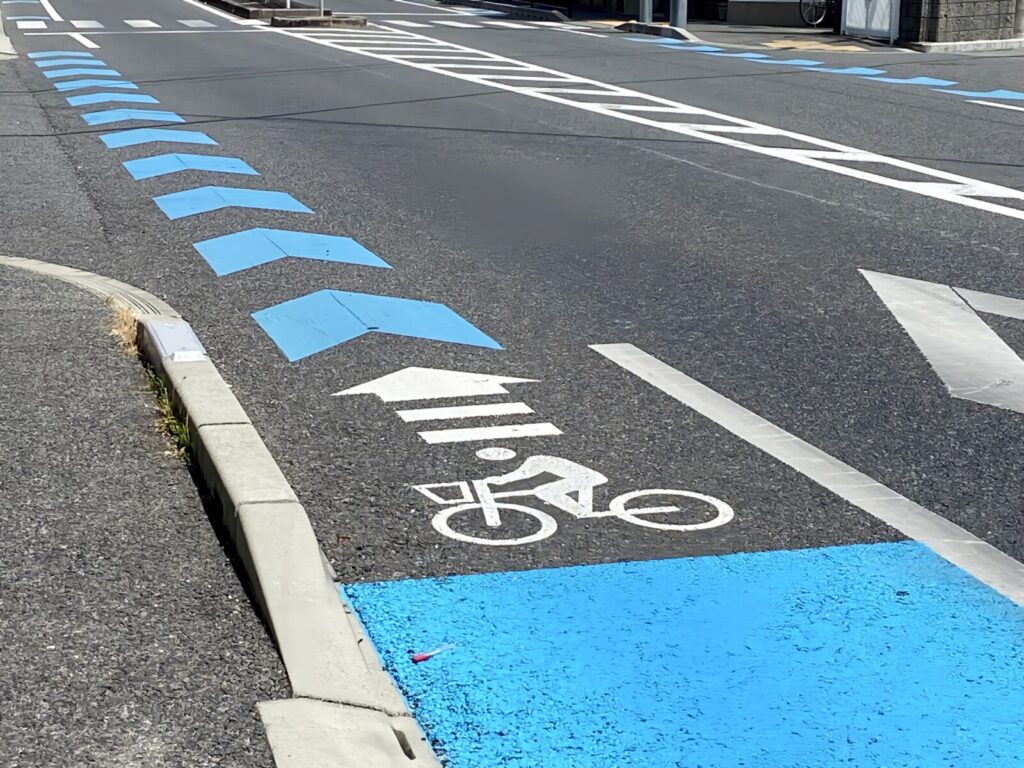
- May roads now have blue sharrows giving an indication of where riders should ride.
- Recently, some roads have been given cycle lanes that are painted in blue
Roads without shoulders still require cyclists to keep as far left as is reasonably safe.
2.2 Roads Where Bicycles Are Prohibited (Even if Not Expressways)
In addition to expressways, some ordinary public roads explicitly prohibit bicycle traffic, even though they may look like normal surface streets.
These restrictions typically apply to:
- High-speed arterial roads designed exclusively for motor traffic
- Bypasses and limited-access national or prefectural roads
- Urban ring roads or elevated road sections
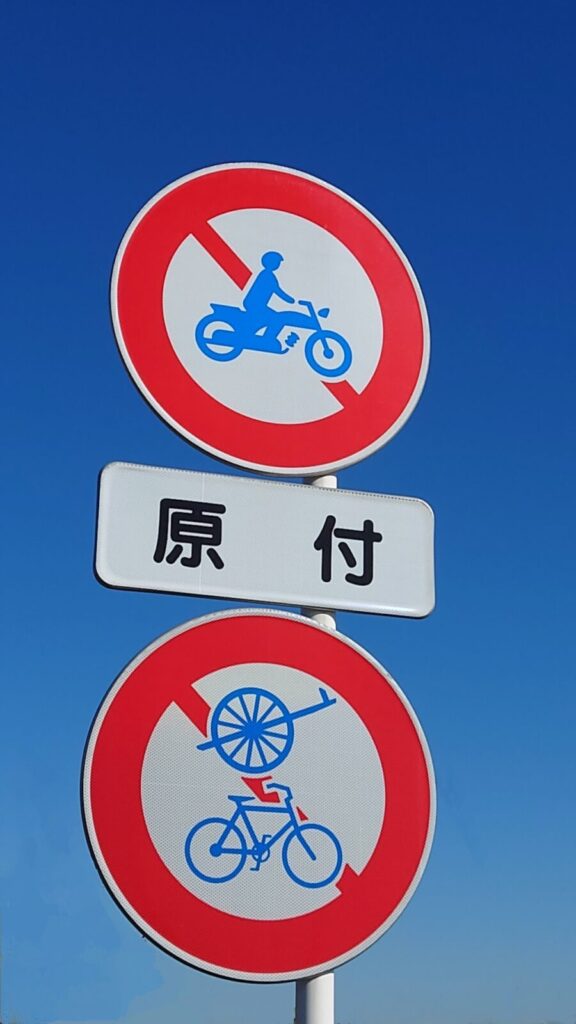
Such roads are marked with a “No Bicycles” (自転車通行止め) sign or a “Light Vehicles Prohibited” (軽車両通行止め) sign. When either sign is present:
- Bicycles may not use the roadway
- Cyclists must detour via an alternative route or use parallel local roads
- In some cases there may be a sidewalk that riders can use
Navigation apps do not always flag bicycle-prohibited segments, so visual confirmation of signage is essential.
2.3 Riding on Sidewalks
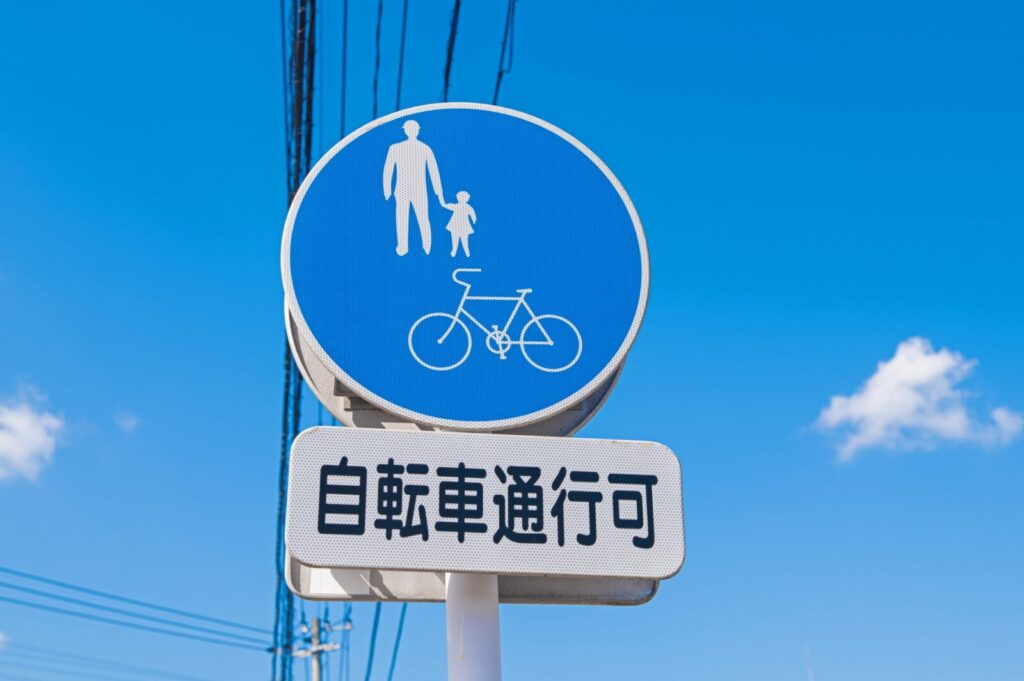
Despite the general rule favoring road use, sidewalk riding is conditionally permitted in Japan. You may ride on the sidewalk if any of the following apply:
- There is a sign explicitly allowing bicycles on the sidewalk (自転車通行可).
- The cyclist is a child under 13, an elderly person (70+), or a person with a disability.
- Road conditions make riding in the roadway particularly dangerous (heavy traffic, narrow lanes, poor visibility).
When riding on a sidewalk:
- Pedestrians always have absolute priority.
- Cyclists must ride at a speed comparable to walking.
- Cyclists must slow down or stop when necessary to avoid pedestrians.
In practice, police tolerate sidewalk riding in many urban areas, but this tolerance does not override the legal duty to yield to pedestrians.
Some sidewalks are also separated into a pedestrian part and a cycle lane.

Lane Positioning and Intersections
General Lane Position
- Keep left, but avoid hugging the curb so closely that debris, drains, or opening car doors become hazards.
- Maintain a predictable line; sudden swerving is dangerous and may be considered negligent.
Turning Right
Cyclists generally can not make direct right turns across traffic like cars. Instead, they use a two-stage right turn (二段階右折):
- Proceed straight through the intersection while staying on the left side.
- Stop at the far corner, reorient the bicycle, and proceed straight when the signal changes.
Some large intersections provide bicycle-specific markings or signals to guide this maneuver.
Traffic Signals and Signs

Cyclists must obey all standard traffic controls, including:
- Cyclists must obey all standard traffic controls, including:
- Traffic lights
- Stop signs (止まれ)
- One-way restrictions
- Pedestrian crossings
Running red lights or ignoring stop signs is a common cause of accidents and is increasingly targeted by police enforcement. In particular, if one goes through a red light and causes a car to honk or put on the brakes the police are likely to fine the offender.
4Railway Crossings (踏切)
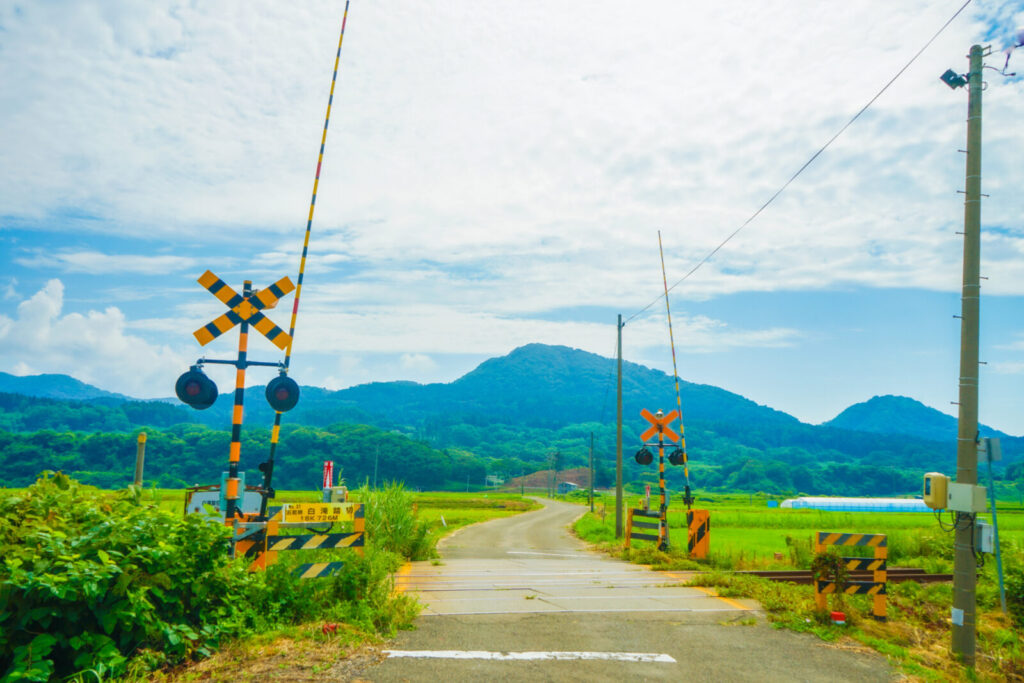
Railway crossings are treated with particular seriousness under Japanese traffic law.
At all railway crossings:
- Cyclists (as well as cars and trucks) must come to a complete stop before entering the crossing, even if the barriers are open and no train is visible.
- Riders must visually and audibly confirm safety in both directions.
- Failure to stop is a traffic violation and may result in a blue ticket.
- Entering a railway crossing when the alarm is ringing or the bars are down is also a serious offence and will almost certainly result in a blue ticket and possibly interrupt train operations
Additional requirements and best practices include:
- Dismounting is strongly recommended, especially where the crossing surface is uneven or rails intersect the road at an angle.
- Narrow tires are at particular risk of slipping into rail gaps; crossing at a shallow angle increases the chance of a fall.
- Do not enter the crossing if there is any risk of being forced to stop on the tracks due to traffic congestion ahead.
If alarms activate or barriers begin to lower while you are still before the tracks, you must wait. If barriers begin to lower after entering, clear the tracks immediately and move to safety. Failure to do so in the presence of a police officer will certainly lead to a ticket.
Police enforcement at railway crossings is strict, and violations are treated as high-risk behavior due to the potentially catastrophic consequences.
Equipment and Bicycle Requirements
Mandatory Equipment
Japanese law requires bicycles to have:
- Brakes (front and rear, brakeless track bicycles are illegal)
- A bell or warning device (use is restricted; see below)
- A white or pale yellow front light at night that is capable of lighting the road surface in front of the bike
- A red rear reflector (a rear light is recommended but not legally required)
Helmets
- Helmets are mandatory for children under 13.
- For adults, helmet use is strongly recommended, and local governments actively promote it.
Recent policy changes emphasize helmet use, and social expectations are shifting toward wider adoption.
Prohibited and Dangerous Behaviors
The following actions are illegal and subject to fines or penalties:
- Riding while using a smartphone or holding an umbrella
- Riding under the influence of alcohol (even small amounts)
- Riding two people on one bicycle (except approved child seats)
- Wearing headphones that significantly impair hearing
- Ignoring traffic signals or stop signs
- Entering railway crossings with the the bars down
Riding While Intoxicated (酒気帯び・酒酔い運転)
Riding a bicycle while under the influence of alcohol is explicitly illegal in Japan and treated far more seriously than many riders expect.
Key points include:
- There is no minimum engine size requirement for drunk-driving laws; bicycles are included.
- Police do not need a specific blood-alcohol threshold to determine intoxication for cyclists.
- Any level of impairment affecting safe riding may constitute a violation.
Two legal categories are commonly applied:
- 酒気帯び運転: Riding with alcohol in the body, even if not visibly drunk.
- 酒酔い運転: Riding while clearly intoxicated and unable to operate the bicycle safely.
Penalties may include:
- Blue tickets or referral to criminal procedures, depending on severity
- Fines that can reach tens of thousands of yen
- Detention or formal charges in serious cases
Importantly, people who provide a bicycle to an intoxicated rider or knowingly allow them to ride may also face penalties.
Police enforcement is especially strict at night, near train stations, and during seasonal events.
From a best-practice standpoint, if you have been drinking:
- Walk the bicycle instead of riding
- Use public transportation or taxis
- Secure the bicycle and retrieve it later
Insurance and Liability
Many prefectures and municipalities now require cyclists to carry bicycle liability insurance (自転車保険).
This insurance covers damage or injury caused to third parties and is especially important given the high compensation awards seen in Japanese court cases involving cyclist negligence.
If you live in Japan, you should confirm local requirements and ensure coverage through:
- Standalone bicycle insurance
- Automobile insurance riders
- Home or renter’s insurance add-ons
Best Practices for Safe and Courteous Riding
Beyond legal compliance, experienced cyclists in Japan follow these best practices:
- Be conservative at intersections: assume drivers may not see you.
- Make eye contact with turning vehicles when possible.
- Signal intentions clearly using hand signals.
- Avoid high-speed riding on sidewalks, even when legal.
- Use lights day and night to improve visibility.
- Park only in designated bicycle parking areas to avoid towing or fines.
Courtesy and predictability are highly valued in Japanese traffic culture and go a long way toward preventing conflicts.
Blue Tickets (青切符) and Bicycle Enforcement
What Is a Blue Ticket?
A blue ticket (青切符) is an on-the-spot administrative traffic violation notice issued by police for relatively minor traffic offenses. Historically, blue tickets were primarily associated with motor vehicles, but enforcement against cyclists has expanded significantly in recent years.
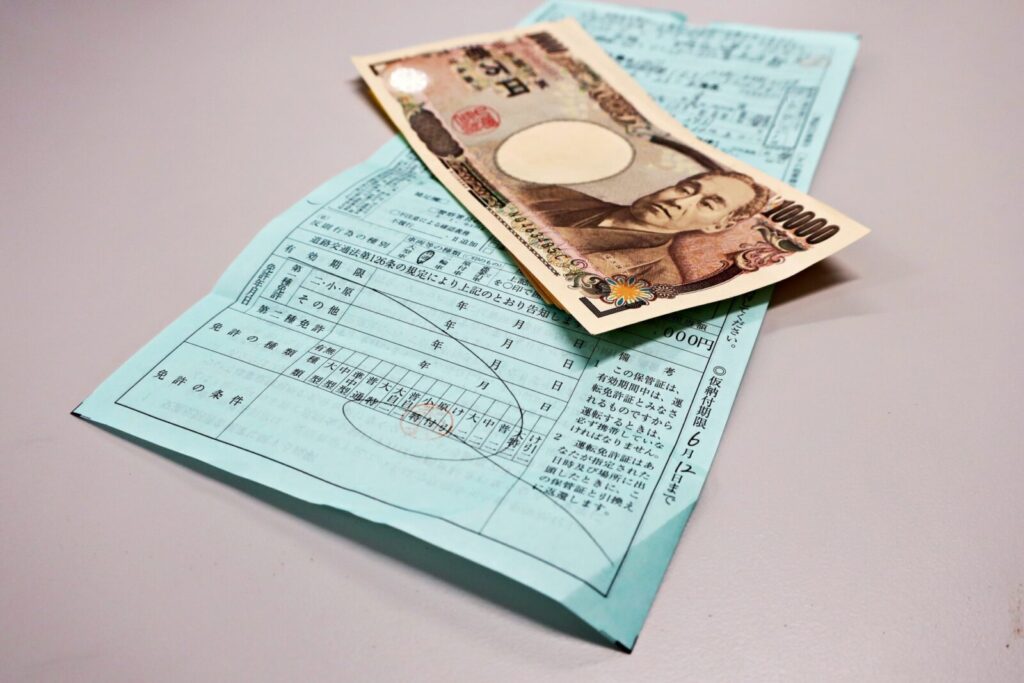
When a cyclist is issued a blue ticket:
- It is not a criminal charge.
- The violation is resolved by paying a fixed administrative fine.
- No court appearance is required if the fine is paid.
Failure to pay a blue ticket may result in escalation to a more serious procedure.
Bicycle Violations Subject to Blue Tickets
Police may issue blue tickets to cyclists for a range of violations, including but not limited to:
- Ignoring traffic signals or stop signs (信号無視・一時不停止) when it causes another driver to have to break
- Riding against traffic on the roadway (逆走)
- Using a smartphone while riding
- Riding under the influence of alcohol
- Dangerous sidewalk riding (excessive speed, failure to yield to pedestrians)
- Ignoring bicycle-specific signs or signals
The exact fine amount varies by violation but is typically several thousand yen.
Warning Cards and Escalation
For some offenses, especially first-time or low-risk violations, police may issue a warning card (指導警告票) instead of a blue ticket. This carries no fine but is recorded.
However:
- Repeated violations increase the likelihood of receiving a blue ticket.
- Serious or dangerous behavior may bypass warnings entirely.
Relationship to Bicycle Safety Courses
Under Japan’s bicycle enforcement system, cyclists who commit serious violations twice within a three-year period may be ordered to attend a bicycle traffic safety course.
Failure to attend such a course can result in additional penalties.
Practical Implications for Cyclists
The introduction and expanded use of blue tickets for bicycles reflects a clear policy shift:
- Cyclists are increasingly treated as full participants in traffic law enforcement.
- “Everyone does it” behavior (wrong-way riding, sidewalk speeding) is no longer reliably tolerated.
- Foreign residents and visitors are not exempt and are routinely ticketed.
Cyclists should assume that visible or dangerous violations can now result in immediate financial penalties.
Enforcement Trends
In recent years, Japan has increased enforcement against dangerous cycling behaviors, particularly:
- Smartphone use while riding
- Ignoring signals
- Wrong-way riding on roads
- Riding while Intoxicated
Repeat offenders may be required to attend bicycle safety lectures, and fines are becoming more common.